Two aluminium window frames can carry the same series name, wall thickness on paper and paint finish, and behave completely differently. The difference is not the metal you can see: it is whether the profile carries an insulated connection between its inside and outside faces, or one continuous piece of aluminium.
What a thermal break is
A thermal break is an insulated, load-bearing connection between the two halves of an aluminium profile — the outside half and the inside half. Aluminium conducts heat better than the polyamide separating the halves, so without one the frame is a single metal path from weather to wall.
The break is structural, not a spacer: the halves are joined through it, and it carries wind load and the weight of the sash. It either exists in the section or it does not. A catalogue describes a straight run; a finished frame has corners, mullion junctions, end caps and reinforcement connections — where fabrication decides what you receive.
The end face shows it — the sample is cut in the wrong place
Nothing outside shows it. The end face does. Two profiles can carry the same finish and the same product name; only one has a break.
A test report does not dictate how a profile is built inside. An AI can hand you a good window specification, but it has no eyes to inspect the section and no hands to act on your behalf. These are sections I photographed at different factories while inspecting for a client recently.
Here they are, side by side: a thermally broken profile, and unbroken ones.
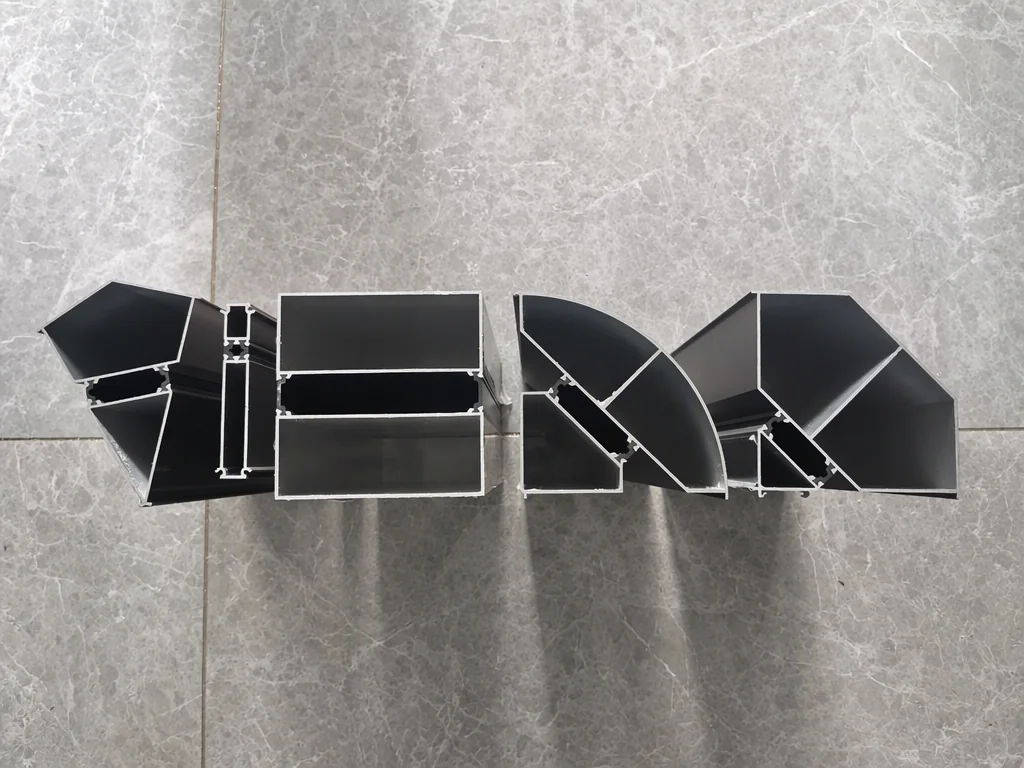
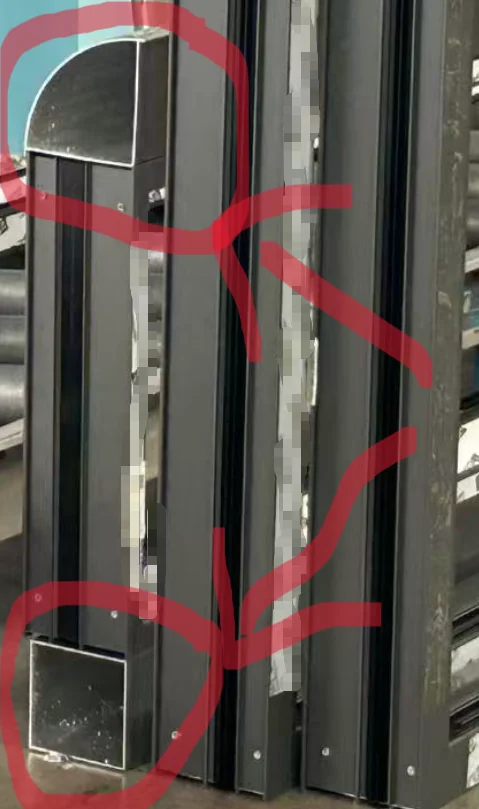
Two profiles, one factory each: with a break, and without one. Carry that into a factory.
Where that question actually lives
On a straight run almost any factory produces the same result: it is the least informative place to cut. The corners, mullion junctions, end caps and reinforcement connections are where what you ordered and what you receive can part company — not because a break is missing there, but because those are the places worth taking apart.
Approval samples are cut from the straight run — where those connections cannot appear. The buyer's check is not limited by eyesight — a sawn section is not hard to read. It is limited by sampling position: the cut is made where the question does not live. The failure is systematic.
Both profiles are quoted under the same product name, and the one without a break can be offered at about 20% less — enough to win the order. Multiply that across a market, and the cheapest quote in your inbox is so often the one with no break.
The right words: a hollow chamber is not a thermal break
A thermal bridge is any high-conductivity path that bypasses the insulation. The cavity inside a profile with no break is a hollow chamber: an air gap inside a metal enclosure. It is not the same as a solid aluminium bar: the cavity resists some heat, but it is not a break.
Two ways to build a break
PA66GF25. A glass-fibre reinforced polyamide strip, crimped into both aluminium halves: strong and machinable, but more conductive than polyurethane. Pour and debridge. Two-part polyurethane is poured in, cured, and the aluminium bridge beneath is milled away — the least conductive of the two, if that bridge is really removed. Neither is a guarantee: both are proven, and both can be done badly. What you can verify is the outcome: is a continuous metal path present?
Width, glass, spacer — and the unit basis your market uses
Break width matters: a wider break lengthens the heat path. Common strips run from 12–14 mm up to 24 mm, and a wider one needs a deeper profile.
Glass matters more than the frame. Double glazing alone is not the performance step; the low-emissivity (Low-E) coating is, reflecting infrared back inside. Argon cuts conduction across the cavity but leaks slowly, so an argon claim is about gas retention and edge sealing. The warm-edge spacer replaces the aluminium bar at the glass perimeter with a low-conductivity design. The weakest element in the assembly sets the result.
R and U are reciprocals, R ≈ 1 ÷ U in US units. A supplier reporting a high R-value and a high U-factor in one document has not read the report they are quoting from. The basis must match your market too:
- North America — NFRC ratings and U-factor.
- Europe and the UK — CE marking under EN 14351-1, declared as Uw in W/m²·K.
- Australia and New Zealand — AS 2047, with safety glazing under AS 1288 and glass products under AS/NZS 2208.
A genuine report on the wrong basis does not carry over: the report is real, the basis is not yours. It stays invisible unless someone checks the basis — the full set is in how to verify a window test report.
Condensation: the symptom buyers actually notice
Most buyers never experience a U-factor. They experience water on a frame.
In a cold climate, a frame with a continuous metal path is pulled toward the outdoor temperature; once its indoor surface drops below the dew point, moisture condenses there — a damp line, darkened paint, eventually mould. In hot, humid air with air conditioning running, the same mechanism shows up on the outside face instead. Surface temperature decides it: the metal path meets the wall wherever the profile carries no break.
What to ask, in writing, before you pay
State in writing that the thermal break must be documented at the connection details — corners, mullions, end caps — not only in the profile line; a straight-run sample cannot show them. The check will be a sawn section from the actual shipment batch, not a straight-run stub. Record the break, the profile and the glass separately, so the first two can be checked against the profile maker's data. Factory side: how we verify factories.
Five questions to send as they are
- Which profile series and profile system maker are you quoting, and what is the measured wall thickness of the frame and sash members in millimetres?
- What is the thermal break — material (PA66GF25, or pour and debridge) and break width in millimetres — and how is it confirmed at the connection details, not just in the profile line?
- Which market basis is the performance report issued on — NFRC (US), EN 14351-1 / CE (EU) or AS 2047 (Australia/NZ) — and which alloy temper is the extrusion supplied in?
- What is the glass build-up, including Low-E type, cavity gas, and spacer type (warm-edge or aluminium)?
- Can you supply a sawn section from the actual production batch, photographed against the sealed approval sample, before the balance is released?
A supplier who has the documentation will send it. One who does not will change the subject. Either response is information.
Frequently asked questions
Is a hollow cavity a thermal break? No. A thermal break is an insulated, load-bearing connection between the profile's inside and outside halves. A hollow cavity with no such bar is a hollow chamber: aluminium still forms a path around it.
Is this a problem with Chinese windows specifically? No — it is a price-comparison problem, and the same gap hides behind the same product name anywhere.
Does break width really matter? Yes: a wider break lengthens the path heat must cross. The trouble is that marketing rarely states the width: "thermally broken", with no width, no material and no word on the connection details.
We do not sell windows, we take no commission or rebate from any factory, and your payment never passes through us. If you want a profile specification and a set of drawings read before you commit, send them over. That is our work.